


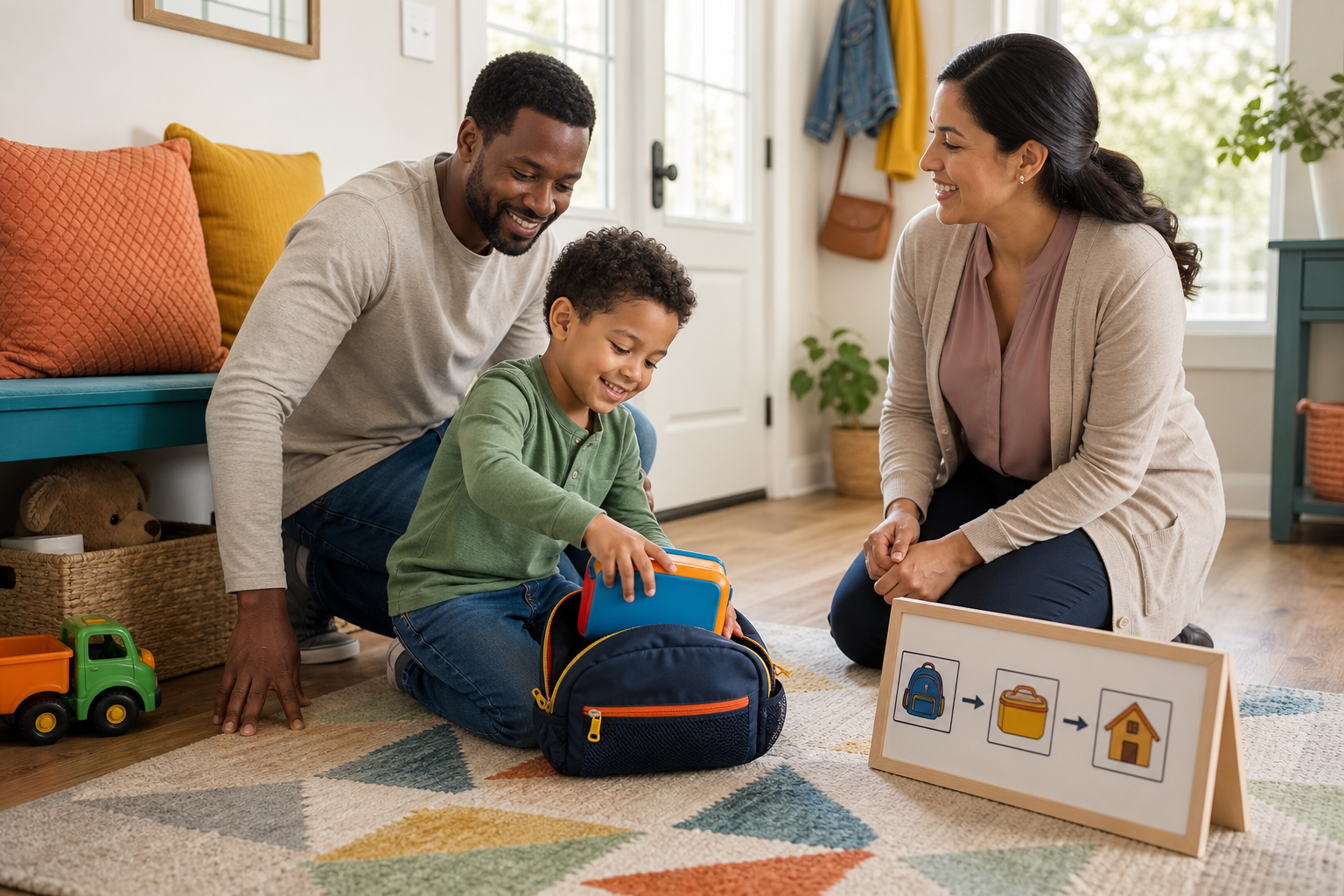
Starting kindergarten can bring a lot of questions. A child may be ready for the next step while still needing support with communication, transitions, self-care, or regulation. An uneven skill profile does not automatically mean a child should delay school.
For an autism school transition with ABA, the goal is not perfect reading, toileting, or emotional regulation. It is helping a child participate in real school routines with the right supports. Families can also review school-based ABA therapy services to understand how school coordination may fit alongside in-home support.
This guide focuses on families preparing a 4- or 5-year-old for kindergarten after early intervention, preschool support, or in-home therapy. Planning can begin with small routines in toddlerhood, but the examples here focus on the preschool-to-kindergarten handoff.
Quick Answer: Is My Child With Autism Ready for Kindergarten?
There is no universal readiness test or single timeline. A child can begin kindergarten with individualized supports for communication, sensory needs, safety, self-help, and access to instruction while other skills are still developing. Readiness is about meaningful participation, not passing a test.
Key facts for families:
- Prioritize communication, transitions, following directions, group participation, self-help, regulation, and safety.
- Start planning several months before school when possible. Earlier practice can make new routines feel more familiar.
- Set goals around the child’s strengths, communication system, sensory profile, autonomy, and safety needs.
- Private in-home ABA, school-owned educational supports, and school-based ABA are different pathways. They may coordinate with consent, but one does not automatically replace another.
If access, health, or safety concerns feel significant, bring them to the family, BCBA, school team, and other relevant professionals. The purpose of planning is to identify useful supports, not to decide a child’s future from a readiness score.
What Classroom Readiness Skills Matter Most?
The most useful classroom readiness skills connect to the routines a child will actually experience. Choose a few priorities instead of trying to master everything at once.
Communication and self-advocacy
A child needs a reliable way to ask for help, a break, the bathroom, more time, or clarification. That communication may use speech, AAC, gestures, signs, pictures, or another system. Adults should respond to the message rather than require a specific mode or eye contact.
Practice might include showing a help card before frustration builds, selecting a break on a visual, or telling an adult that a lunch container will not open. The goal is to make communication useful and respected across settings.
Directions, group participation, and waiting
School routines often involve a one- or two-step direction, a short group activity, brief waiting, turn-taking, and moving from a preferred activity to a shared one. Success does not mean sitting still on demand. It means having enough support to access the activity and gradually build independence.
Transitions and flexible participation
Arrival, cleanup, lining up, room changes, and schedule changes can be hard when a child is leaving a familiar routine. Visual schedules, first/then language, transition warnings, previews, and gradual practice may help. The right combination depends on the child and should be adjusted when a support adds stress instead of reducing it.
Self-help, regulation, and safety
Practice manageable steps related to a backpack, lunch container, dressing, hand hygiene, bathroom communication, and safe movement through school spaces. Plan for sensory needs, safe breaks, elopement risk, and other safety concerns when they apply.
Perfect toileting or self-regulation is not a prerequisite for belonging in kindergarten. Support should not suppress harmless stimming or force a child through distress. It should give the child more ways to communicate, recover, and take part.
Early academic exposure without academic pressure
Early literacy and numeracy exposure can support participation, but academic mastery is not the readiness test. Communication, instruction access, autonomy, and safety deserve equal attention.
The HOME-to-K Transition Map
The HOME-to-K Transition Map is a planning map, not a readiness score. It helps families choose meaningful priorities for the move from early intervention or in-home support to kindergarten.
Hear the child first
Start with strengths, preferred communication, AAC or gestures, regulation signals, sensory needs, autonomy, interests, and safety. The target is participation and self-advocacy, not making a child appear more typical. Before choosing a practice demand, identify what helps the child communicate and recover.
Observe the school routines
Select two or three routines that have the greatest effect on school access, such as arrival, group time, transitions, help or break requests, lunch, bathroom, or peer activities. Describe what the child does now, where the routine becomes difficult, and what support could make participation easier.
Match practice across settings
Practice those priorities at home, in the community, in preschool, or during short classroom-like activities. Vary adults, materials, noise, waiting, and timing gradually. When appropriate, fade prompts, visuals, modeling, or reinforcement toward greater independence.
For example, a child might first practice asking for help with a lunch container at home, then with a less familiar adult, and later in a busier setting. The point is not to recreate a classroom perfectly. It is to help the skill become useful beyond one familiar session.
Exchange a shared plan
Create a short, consent-based profile with strengths, communication supports, regulation signals, safety information, helpful cues, and next steps. Family, BCBA, RBT, teacher, and school team members may contribute, but their roles differ.
An IEP is the public school’s educational plan. Private ABA does not automatically become an IEP service, and a private provider does not control school placement. Clear role boundaries make collaboration easier for everyone.
Review the first month
Use caregiver and teacher observations to identify what works, where access is still blocked, and which supports need adjustment. Ask for a team conversation or evaluation when educational access or safety remains a concern. Celebrate communication, participation, recovery, and growing independence, not compliance alone.
How In-Home ABA Can Support the Home-to-Classroom Bridge
In-home ABA can help a child practice functional routines where they naturally occur. Caregiver coaching and planned generalization can make those skills more useful outside the home, but in-home ABA does not provide school services or control placement.
Able Minds ABA describes its approach as a Parent-Professional Partnership. Its services include BCBA-designed individualized plans, RBT implementation, caregiver coaching, in-home support, school-based consultation or support, and telehealth options for parent coaching or remote clinical supervision. The aim is to connect therapy with a family’s daily rhythm rather than isolate practice in one setting.
A practice-to-school sequence may look like this:
- Identify a meaningful routine and the child’s current support needs.
- Practice it in a familiar home context.
- Vary people, materials, timing, noise, and location gradually.
- Coordinate with the school team when permission and role clarity allow.
- Review whether prompts can be reduced and participation is becoming more independent.
Examples include requesting a break during a busy routine, following a two-step direction while distracted, waiting for a turn, opening lunch, using a visual schedule, and communicating bathroom or safety needs. A skill used during therapy may not yet be reliable with a new adult, in a noisy room, or under time pressure. Planned variation gives the team a way to notice that gap and respond.
In-home ABA cannot guarantee classroom success, replace an IEP, substitute for speech or occupational therapy, or remove the need for school approval. For families comparing service settings, school-based ABA therapy services offers a separate overview of how school support and coordination may work.
What to Do Before Kindergarten in Maryland and Virginia
Use this sequence as a planning guide, not a legal or insurance checklist. Confirm current dates, eligibility rules, district procedures, and service availability before acting.
Several months before school
Review evaluations, IFSP or IEP status, communication supports, safety needs, and the two or three priorities selected in the HOME-to-K map. Ask the early-intervention, preschool, school, and clinical teams what information should transfer and what may need a fresh evaluation. Do not assume one statewide deadline applies to every family.
Before summer or school visits
Align home practice with school-relevant routines without turning the home plan into an IEP. When available, plan a school visit, route preview, arrival practice, and a visual or social story using the actual setting. Ask about AAC access, bathroom support, sensory breaks, transition warnings, safety, and how the family will communicate with the school.
Before day one and during the first month
Share a concise child profile with strengths, communication, regulation signals, helpful supports, safety information, and what adults should try first. Use a predictable communication channel with the school team. Review real-world observations after the first weeks and request a team conversation if the current supports are not working.
Maryland transition context
Maryland families may move from the Maryland Infants and Toddlers Program and an IFSP into preschool or school-system planning. The process and timing depend on the child’s circumstances and local school system. Families can review the Maryland family transition guide and confirm current details with the appropriate local team.
Virginia transition context
Virginia families may move from early intervention into local school-division or Early Childhood Special Education planning. The Virginia Department of Education guidance for children with disabilities and PEATC transition-to-kindergarten resource provide useful context. Local procedures can differ, so families should confirm next steps with their school division.
Private or Medicaid-funded ABA, school-based ABA, IEP services, school permission, and related services are separate pathways. They may coordinate, but they are not interchangeable. Avoid relying on unverified insurance, authorization, licensure, or district claims.
How Families, BCBAs, and School Teams Can Share a Plan
Families should not have to translate every therapy detail alone. A useful handoff is a short, consent-based summary of what helps the child participate, with clear role boundaries and a way to review what happens in the real school day.
What to share with the new team
Share the child’s strengths, communication and visual supports, regulation signals, sensory and safety needs, bathroom or lunch support, and successful transition cues. Add what works with support, what breaks down in new settings, and what adults should try first.
Who does what
- Parent or caregiver: Provide context, priorities, consent, and daily observations.
- BCBA or ABA team: Explain individualized goals, relevant observations, caregiver coaching, and ways to practice generalization while respecting school authority.
- Teacher and school team: Determine educational supports, IEP implementation, classroom accommodations, and school-based decisions.
- RBT: Implement the approved plan within the assigned role and coordinate through the supervising clinical team.
For more on cross-setting goal alignment, read how to keep a school and ABA provider communicating. If the family needs a deeper overview of school and home goal alignment, how IEP goals can align with ABA goals offers additional context.
First-month feedback loop
Track a small number of observations rather than asking a parent to become the therapist. Review arrival, transitions, communication, group access, lunch or bathroom routines, regulation, and safety. Ask which supports helped, what remains difficult, and who owns the next step.
HOME-to-K Transition Planner
Use this planner as a conversation tool, not a diagnostic instrument, placement recommendation, or replacement for clinical or school-team judgment.
- Child strengths and communication profile: Preferred communication, AAC or visual supports, regulation signals, sensory needs, interests, autonomy, and safety considerations.
- Priority school routines: Select only two or three routines, such as arrival, group time, transitions, help or break requests, lunch, bathroom, or peer activity.
- Current supports and practice settings: Record what works at home, what changes in the community or preschool, who can practice, and which prompts or visuals are being faded.
- Maryland or Virginia transition timeline: Note evaluations, school visits, information sharing, questions for the school team, and current state or district follow-up.
- First-month review: Record what helped, what remains difficult, who owns the next step, and when the adults will reconnect.
Complete the planner with the caregiver and BCBA, share only relevant information with the school team, and revisit it after school starts. It should connect the adults around the child without making the parent a full-time therapist or requiring mastery before kindergarten.
FAQ
Is my child with autism ready for kindergarten?
Readiness is not a universal pass or fail test. Consider communication, instruction access, safety, support needs, and the child’s current profile. Uneven skills do not automatically mean a delay.
What classroom readiness skills should we practice at home?
Prioritize communication, help or break requests, transitions, directions, group participation, self-help, regulation, and safety. Practice them in real routines. Perfect academics are not prerequisites for kindergarten.
How can in-home ABA help with the transition from early intervention to school?
In-home ABA can use natural routines, caregiver coaching, BCBA-guided goals, and gradual generalization to practice school-relevant skills. It does not replace educational planning or automatically become a school service.
Does an IEP include private ABA in Maryland or Virginia?
An IEP is the public school’s educational plan. Private medically funded ABA is separate, although teams may coordinate with consent. Review current state and local guidance for process questions.
Can private in-home ABA continue after school starts?
Continuation depends on the child’s individualized plan, family needs, provider availability, funding, schedule, and coordination requirements. Do not assume hours or coverage. Discuss how home services and school supports can fit together.
Should we delay kindergarten for a child with autism?
There is no universal answer. Timing and placement depend on evaluations, the child’s needs, family context, and available supports. Use the HOME-to-K map to identify support needs, not to produce a readiness score or a provider’s unilateral recommendation.
Families in Maryland and Virginia can begin with the two or three routines that matter most to their child’s school access, then build a shared plan with the adults who support them. To understand how Able Minds ABA approaches coordination beyond the home, read about school-based ABA therapy services.
