


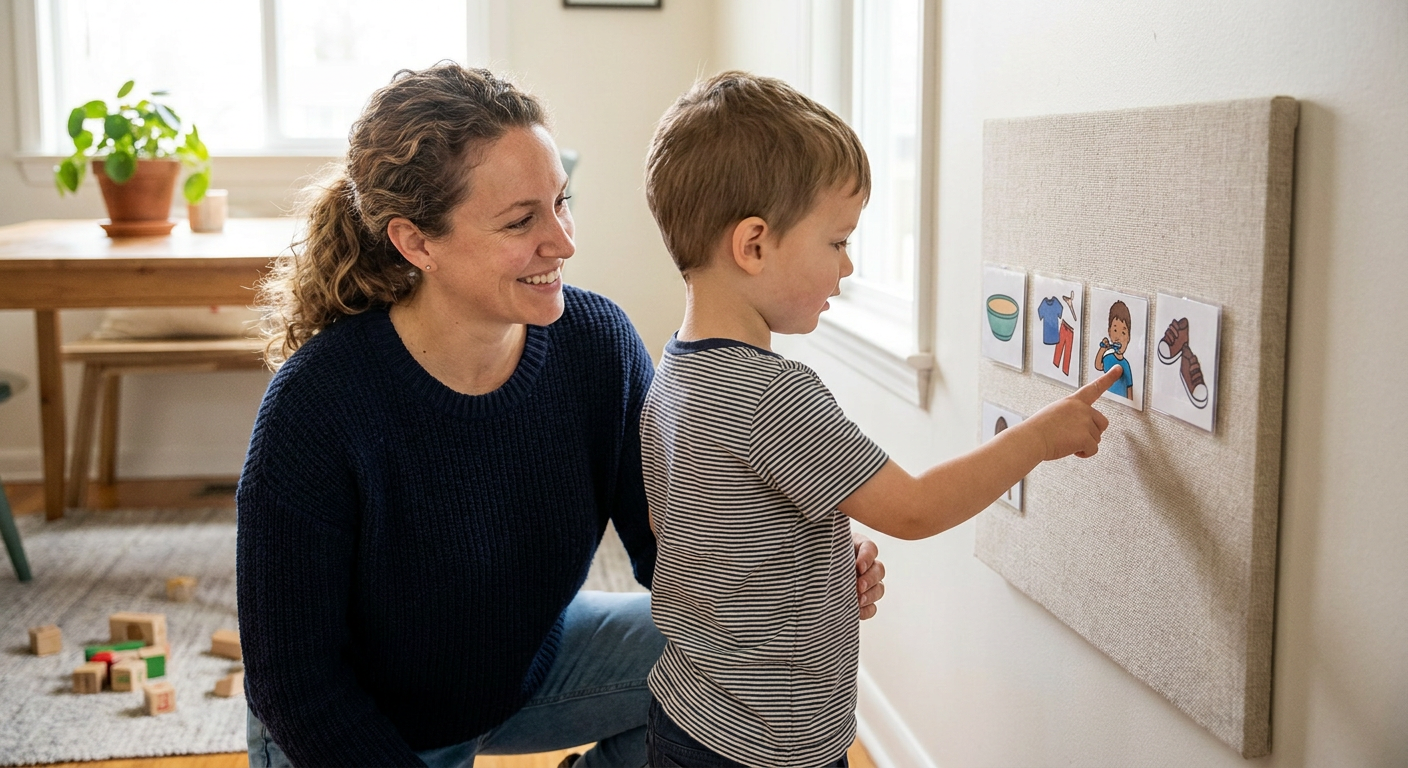
If mornings feel rushed, bedtime turns into a battle, or everyday transitions seem harder than they should, you are not alone. Many parents who are new to ABA are looking for something simple that can make home routines feel calmer and easier to follow.
A visual schedule can be a good place to start. It helps your child see what is happening now, what comes next, and when a routine is finished. That kind of predictability can lower stress for both you and your child.
A visual schedule is not a quick fix, and it is not meant to force compliance. It is a practical support that can make daily routines easier to understand and easier to move through. If you are still getting oriented to the bigger picture, this starting-point guide for families after a new diagnosis can help. In this article, we will stay focused on one tool: how to create a visual schedule at home, how to choose the right format, and how to introduce it without adding more pressure.
What a visual schedule is at home, and what it is not
A visual schedule is a set of pictures, icons, words, or short written steps that shows the order of a routine. At home, that routine might be getting ready for school, coming home after school, brushing teeth, cleaning up toys, or getting ready for bed.
In simple terms, a visual schedule breaks a routine into smaller parts and makes those parts easier to see. In ABA, that matters because many children do better when expectations are clear, predictable, and consistent. A schedule can also give adults a steadier way to prompt a routine and gradually step back as the child becomes more familiar with it.
What it is not is just as important. A visual schedule is not a punishment tool, a chore chart, or a rigid system that has to be followed perfectly every time. It should fit your child’s age, communication style, attention span, and comfort with change. If you want more background on how predictable routines can support calmer days, this piece on making daily routines more manageable gives broader context.
When a visual schedule can help most at home
A visual schedule often helps when the hardest part of the routine is not the task itself, but the transition into it. Your child may know how to brush their teeth or put on shoes, but still struggle with starting, switching, waiting, or moving through the steps in order.
At home, that can look like:
- needing repeated reminders to get through the morning routine
- getting upset when screen time ends and dinner starts
- having trouble settling into an after-school routine
- struggling with bedtime because the steps feel unclear or rushed
- resisting cleanup, toileting, or short waiting periods
For younger children, the most helpful schedules are usually short and concrete. Real photos or simple picture cards often work better than abstract symbols. Older children may do better with a checklist, word-based schedule, or a mix of pictures and text.
Visual supports can be useful, but they are not a guarantee. If routines still lead to frequent distress, major transition problems, or ongoing conflict after you have simplified the schedule, that may be a sign to get more individualized support from a BCBA or therapist. If you want a broader look at how home supports can build confidence over time, this article on building independence at home is a helpful next read.
How to choose the first routine and the right visual format
Start with one routine only. That one decision can make the process feel much more manageable.
Pick the routine that happens often and causes the most repeatable friction. For many families, that is morning prep, after-school time, bedtime, cleanup, toileting, or a transition away from a preferred activity. Try to begin with a routine that is short enough to teach without overwhelming your child.
A simple three-step routine is usually easier to introduce than a long, detailed one. Early wins matter.
Next, choose the format that best matches how your child already understands information:
- Real photos: useful for younger children or children who respond best to familiar, concrete visuals
- Simple icons or picture cards: a good fit when your child recognizes symbols consistently
- Written words: often helpful for older children who read or process text well
- Picture and word cards together: useful when your child is moving toward more independence
- A whiteboard or checklist: often a good option for school-age children who like simple written steps
- A digital schedule: helpful for some children, as long as the device itself does not become a distraction
There is no best-looking version. There is only the version your child can actually use. If after-school routines are the biggest pain point right now, this guide on homework routines and after-school meltdowns can help you think through that part of the day.
MATCH Routine Method
A simple way to build and teach a visual schedule is to move through five steps: Map, Align, Teach, Check, and Hand off.
M: Map the moment
Choose one routine and define the exact part that is breaking down. Is the challenge getting dressed, leaving the house, starting homework, or moving from bath time to bed?
Be specific. “Get ready for school” is broad. “Use the bathroom, get dressed, put on shoes, grab backpack” is much easier to show and teach.
A: Align the visual level
Match the schedule to your child’s current communication and processing level. A child who is not yet reading may need photos. A child who reads may do well with short written steps. Some children benefit from seeing both a picture and a word together.
This choice should be based on your child, not on what looks polished online.
T: Teach with support
Introduce one routine at a time. Show the schedule before the routine begins, point to each step as it happens, and keep your language brief and calm. If reinforcement helps your child stay engaged, keep it immediate and simple.
The schedule should feel supportive. If adults are giving too many reminders, repeating the same directions over and over, or guiding every move, the child may rely on the adult instead of learning how to use the schedule.
C: Check the friction points
Pay attention to patterns. Does your child skip one step every time? Get upset when the order changes? Ignore the schedule? Need help only at one specific point?
That information matters. Before deciding the schedule is not working, ask whether it is too long, too abstract, in the wrong place, or still too dependent on adult prompting.
H: Hand off independence
As the routine becomes more familiar, start fading support. That might mean pointing less, waiting a little longer before stepping in, or letting your child move a finished card on their own.
Independence usually builds little by little. If flexibility is a challenge, this article on helping kids handle unexpected changes offers useful next-step ideas.
Real-life examples of visual schedules for home routines
A visual schedule does not need to be complicated to help. In many cases, the simplest version is the most useful.
A morning routine might include: use the bathroom, get dressed, eat breakfast, brush teeth, put on shoes, grab backpack. For a younger child, that may be four to six photo cards. For an older child, it might be a short checklist by the door. If mornings are especially difficult, these morning routine tips go deeper.
An after-school schedule might include: snack, change clothes, homework, break, playtime. This can help when the shift from school demands to home expectations creates stress.
A bedtime routine might include: bath, pajamas, brush teeth, choose one book, lights out. For many children, fewer steps are better at first. If bedtime is a frequent struggle, these bedtime support ideas may help.
A toileting routine might include: go to bathroom, pants down, sit, wipe, flush, wash hands.
A cleanup routine might include: toys in bin, books on shelf, choose next activity.
The goal is not to make the routine look perfect on paper. The goal is to make the next step easier for your child to understand.
How to introduce the schedule without creating more stress
Keep the first week simple. Start with one routine. Place the schedule where the routine actually happens. Use the same wording across caregivers when you can. Keep the number of steps realistic.
When you introduce it, show the schedule before the routine starts. Move through it with calm repetition. If your child ignores it, shorten the routine, switch to more concrete visuals, or make the schedule easier to see. If your child resists transitions, look closely at the specific point where the friction begins instead of assuming the whole system is wrong.
If your child depends heavily on adult prompts, try fading one layer at a time. Point instead of repeating. Pause before stepping in. Let the schedule do more of the work.
Reinforcement can help during the teaching stage, but it should support engagement rather than create pressure. If you want more context, this article on why rewards often work better than punishment explains that approach clearly, and this guide on supporting progress between ABA sessions can help families stay consistent at home.
If the routine still leads to frequent meltdowns, high stress, or ongoing prompt dependence even after you simplify it, that is a reasonable time to ask for BCBA guidance. More support does not mean you failed. It may just mean the routine needs a more tailored plan.
Visual Schedule Starter Checklist for Parents New to ABA
Before you print, write, or laminate anything, use this quick checklist:
- Pick one routine that causes repeated daily friction.
- Match the format to your child’s current communication level.
- Keep the number of steps realistic for your child’s age and attention span.
- Decide where the schedule will live and what materials you need.
- Make a simple prompting plan so caregivers respond in a similar way.
- Identify what kind of reinforcement or encouragement helps your child stay engaged.
- Build a flexibility plan for days when the routine changes.
- Watch whether conflict is decreasing and whether the schedule needs to be simplified.
For many parents, this checklist is most useful during the first week, before the schedule is introduced.
FAQ
What is a visual schedule for autism?
A visual schedule is a sequence of pictures, icons, words, or short written steps that shows what happens during a routine. At home, it helps make the order of activities easier to understand.
How do visual schedules help autistic children at home?
They can support transitions, sequencing, and predictability. That may reduce confusion and make daily routines feel more manageable.
How do you make a visual schedule for autism at home?
Choose one routine, pick a format your child can understand, keep the number of steps manageable, and introduce it gradually with calm support.
Should I use pictures, icons, or words?
Use the format that best matches your child’s age, communication level, and how they process information. Younger children often do better with photos or simple pictures, while older children may prefer words or checklists.
Are printable or digital visual schedules better?
It depends on the child and the routine. Printable or DIY schedules are easy to place where the routine happens. Digital schedules can work well for some children, but only if the device itself does not become distracting.
When should I ask a BCBA or therapist for help?
It may be time to ask for support if routines still lead to frequent distress, the schedule creates more conflict than clarity, or your child stays highly dependent on adult prompts even after the routine has been simplified.
A visual schedule works best when it fits real life. For many families, it becomes one small but meaningful support that helps daily routines feel steadier, clearer, and more manageable over time.
